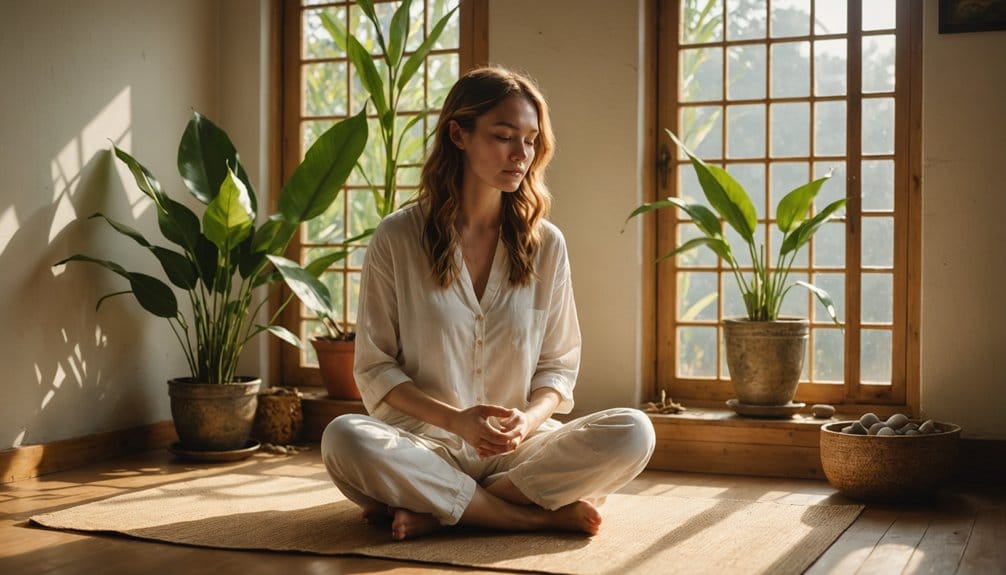
You’ll find fascinating breathing techniques woven into meditation practices across cultures worldwide. From Buddhist monks counting breaths to Indigenous Americans syncing with drumbeats, each tradition offers unique approaches. Japanese Zen masters focus on simple awareness, while Yogic practitioners use specific patterns like ocean breath and skull-shining. Chinese Taoists work with qi energy, and African tribes integrate communal rhythms. These time-tested methods hold ancient wisdom for modern-day peace of mind.
Ancient Buddhist Pranayama Methods
Three foundational breathing techniques from ancient Buddhist tradition have stood the test of time – and they’re probably not what you’d expect. Buddhist mindfulness starts with simply counting your breaths. You’d think that’s easy, right? Just try making it to ten without your mind wandering off to your grocery list!
The second method involves following your breath like it’s your favorite Netflix series. You’ll track each inhale and exhale from start to finish, noticing every subtle sensation. The third technique, called breath awareness, asks you to focus on that tiny pause between breaths. It’s like finding the space between musical notes – tricky at first, but surprisingly revealing once you get the hang of it. Who knew something as simple as breathing could be so fascinating? Additionally, these techniques highlight the principle of breath awareness, fostering a deeper connection between body and consciousness.
Japanese Zen Breathing Practices
While ancient Buddhist practices laid the groundwork, Japanese Zen masters took breathing techniques to a whole new level of precision – and sometimes peculiarity. You’ll find yourself sitting in zazen posture, which might feel a bit like trying to fold yourself into a human pretzel at first. Don’t worry, you’ll get used to it!
The key is breath awareness, but not in the way you might expect. Instead of counting breaths or following complicated patterns, you’re simply asked to… well, breathe. Sounds easy, right? Here’s the catch: you’ll need to maintain complete awareness of each breath without actually thinking about it. If that sounds like trying to not think about pink elephants, you’re getting the idea. It’s delightfully simple, yet surprisingly challenging. This practice emphasizes mindful awareness, helping individuals engage fully with each breath and experience the present moment.
Chinese Taoist Breath Cultivation
As ancient Taoist masters discovered the secrets of “qi” (life force energy), they developed a fascinating system of breath cultivation that’s a bit like being your own internal orchestra conductor.
In Taoist principles, you’ll learn to direct your breath’s energy flow through visualization – imagine golden light flowing through your body with each inhale. You’re not just breathing; you’re conducting qi cultivation through specific meditation alignment practices. Think of it as upgrading your ordinary breathing to mindful breathing 2.0!
Through breath activation exercises, you’ll connect with your inner harmony in ways you never thought possible. It’s amazing how a few simple techniques can transform your energy levels. When you practice these methods regularly, you’ll start feeling like you’ve got your own internal power plant working at peak efficiency. This breath control practice directly influences the nervous system, helping to promote a deep sense of relaxation and calm.
Indigenous American Sacred Breath Work
Long before modern wellness trends took over social media, Indigenous American cultures developed profound breathing ceremonies that you’ll find surprisingly relevant today. These sacred rituals weren’t just about taking deep breaths – they connected people to the natural world through carefully structured breathing patterns.
Ever wondered why smoke from sacred herbs plays such a big role in Native ceremonies? It’s because breath itself carries cultural significance as a bridge between physical and spiritual domains. You’ll notice how many tribes incorporate rhythmic breathing with drumbeats and vocal tones, creating what modern practitioners might call a “meditative state.” But here’s the thing – these weren’t just relaxation techniques. They were (and still are) powerful tools for healing, vision-seeking, and connecting with ancestral wisdom. Conscious connected breathing significantly enhances emotional resilience and promotes a deeper inner calm, making it a practice that resonates across various cultures.
African Tribal Breathing Rituals
Much like their Indigenous American counterparts, traditional African breathing practices weave together physical techniques with rich spiritual meaning. You’ll find these ancient methods deeply intertwined with tribal music and communal rituals that have been passed down through generations.
Picture yourself in a circle of drummers, where the rhythm guides your breath in a powerful call-and-response pattern. Many African tribes use specific breathing patterns that sync with drum beats – inhaling for four counts, holding for seven, then releasing for eight. It’s not just about the breath itself; it’s about connecting to something bigger. Whether you’re practicing alone or in a group, these techniques help you tap into what African elders call “the breath of life” – your essential connection to both earth and spirit.
Yogic Breathing in Hindu Traditions
You’ll find yogic breathing, called pranayama, at the heart of Hindu meditation – it’s like learning to be the DJ of your own breath. Through techniques like alternate nostril breathing (which might make you feel a bit silly at first but works wonders), you’re actually tapping into ancient wisdom that’s been fine-tuned over thousands of years. Whether you’re a beginner just learning to count your breaths or an experienced practitioner mastering advanced breath control, these time-tested methods offer something for everyone who wants to find their inner calm. Incorporating practices like alternate nostril breathing can enhance stress relief and promote overall relaxation.
Ancient Pranayama Fundamentals
While modern mindfulness practices often borrow from ancient wisdom, pranayama stands as one of humanity’s oldest and most sophisticated breathing techniques. You’ll find its roots stretching back thousands of years in Hindu traditions, where breath awareness wasn’t just about relaxation – it was a path to enlightenment.
The fundamentals are surprisingly straightforward: you’re working with your breath in three parts – inhale (puraka), hold (kumbhaka), and exhale (rechaka). Think of it as giving your lungs a good workout! The pranayama benefits go way beyond just feeling calmer – you’re tapping into what ancient yogis called “life force energy.” Ever notice how a few deep breaths can completely change your mood? That’s just scratching the surface of what these time-tested techniques can do for your mind and body.
Alternate Nostril Benefits
Three key benefits make alternate nostril breathing, or Nadi Shodhana, stand out among yogic practices. First, you’ll notice an immediate sense of mental clarity – it’s like hitting the reset button on your busy mind. Second, this alternate nostril practice helps balance your nervous system, making you feel both energized and calm at the same time (yes, it’s possible!).
The third benefit might surprise you: alternate nostril effects include improved respiratory function. By consciously breathing through each nostril, you’re actually training your airways to work more efficiently. Ever noticed how one nostril is usually more blocked than the other? This technique helps normalize that natural pattern. Think of it as a tune-up for your breathing system – and who doesn’t want their internal engine running smoothly?
Breath Control Methods
Ancient Hindu traditions offer a treasure trove of breath control methods that go way beyond just alternate nostril work. You’ll find techniques like Kapalabhati (rapid-fire “skull-shining” breaths), Bhastrika (bellows breath), and the soothing Ujjayi (ocean breath). Each carries its own cultural significance and unique benefits.
Want to try one? Start with Ujjayi – it’s like fogging up a mirror with your breath, but with your mouth closed. You’ll create a soft, oceanic sound in the back of your throat that’s surprisingly calming. Think Darth Vader, but more zen! This technique’s particularly great when you’re stuck in traffic or dealing with that coworker who just won’t stop talking. Remember, though, these aren’t just exercises – they’re gateways to deeper states of consciousness that yogis have refined over thousands of years.
Sufi Breathing Techniques and Practices
Every Sufi breathing practice connects directly to the divine through mindful awareness and rhythmic patterns. You’ll find that the Sufi breath isn’t just about inhaling and exhaling – it’s a spiritual journey that transforms your entire being. As you engage in rhythmic inhalation, you’re creating a divine connection that aligns your heart with universal energy.
Ever wonder why whirling dervishes can spin for hours? They’ve mastered these mystical practices of breath energy! You’ll start by focusing on your heart center while breathing slowly and deeply. Then, you’ll gradually build up to synchronized movements that match your breath. Don’t worry if you get dizzy at first – that’s totally normal. The key is to let your breath guide you, just as it’s guided Sufi practitioners for centuries in their pursuit of divine unity.
Modern Western Adaptations of Breath Work
Western wellness practitioners have transformed traditional breathing techniques into modern, accessible practices that fit our busy lifestyles. You’ll find mindful breathing exercises that take just minutes to calm your racing thoughts – perfect for that pre-meeting anxiety!
Through simple breath awareness and visualization techniques, you’re learning to notice your breath patterns and adjust them for stress reduction. Ever tried syncing your breath rhythm to your walking pace? It’s a game-changer for your daily commute. Modern breath exercises combine ancient wisdom with practical applications, like using breath synchronization during your workout or practicing breath visualization while stuck in traffic.
These adaptations make traditional practices more relatable – because let’s face it, you probably won’t be meditating on a mountaintop anytime soon!
Scientific Research on Global Breathing Methods
You’ll be amazed how modern science validates what ancient cultures knew all along about breathing techniques – they really work for stress relief. Brain scans now show measurable changes in neural activity when you practice traditional methods like Buddhist pranayama or Sufi breath control, with researchers documenting reduced anxiety and improved focus across different cultural approaches. While your ancestors might not have had EEG machines to prove it, they were definitely onto something when they developed these time-tested breathing practices that scientists are now keenly studying in labs around the world.
Studies Support Stress Relief
How remarkable is it that ancient breathing practices are now being validated by modern science? You’ll be amazed to learn that researchers have documented significant stress reduction benefits across various cultural breathing techniques. From Harvard to Stanford, studies show these time-tested methods really work!
When you’re feeling overwhelmed, your body’s stress response kicks into high gear. But here’s the good news: controlled breathing can help you regain your cool. Research indicates that regular practice of traditional breathing exercises improves emotional regulation and lowers cortisol levels. You might think it’s just sitting there breathing (which, let’s face it, we do anyway), but these specific techniques actually trigger your body’s relaxation response. Think of it as your built-in chill pill – no prescription needed! The data confirms what practitioners have known for centuries: mindful breathing is a powerful stress-busting tool.
Measuring Brain Wave Changes
Recent brain imaging studies reveal three distinct wave patterns during meditative breathing practices from different cultures. You’ll find alpha waves dominating during Zen breathing, theta waves increasing with yogic pranayama, and gamma waves spiking in Tibetan meditation. Isn’t it fascinating how different mindfulness techniques can literally rewire your brain?
When you’re practicing these ancient methods, your brain wave patterns shift dramatically. Think of it like changing radio stations – each frequency brings a different mental state. Scientists have tracked these changes using EEG monitors, showing how Japanese zazen creates calm focus, while Indian alternate-nostril breathing enhances memory. Even better, you don’t need fancy equipment to benefit from these techniques. Your brain’s getting a workout whether you’re counting breaths like a Buddhist monk or humming like a yoga master.