You’ve probably tried meditation before – maybe sitting cross-legged for five minutes while your mind bounces around like a caffeinated squirrel. But advanced Zen techniques take this practice to an entirely different level. Beyond the basics of counting breaths and fighting off leg cramps, there’s a fascinating world of ancient methods that can transform your consciousness. Ready to discover how masters achieve those legendary states of enlightenment? Let’s explore the advanced territory of Zen meditation.
Cultivating Shikantaza: The Art of “Just Sitting”
Shikantaza, the cornerstone of Zen meditation, isn’t your typical “clear your mind and think happy thoughts” practice. It’s about diving deep into pure awareness without grasping at specific objects or goals. Think of it as being the sky rather than chasing clouds.
Following shikantaza principles means you’ll sit in complete stillness awareness, but here’s the fun part – you’re not trying to achieve anything. Sounds counterintuitive, right? While your mind might protest “but I need to accomplish something!”, inner silence emerges naturally when you stop forcing it. Your mindfulness expansion happens organically, like a flower blooming without being told how.
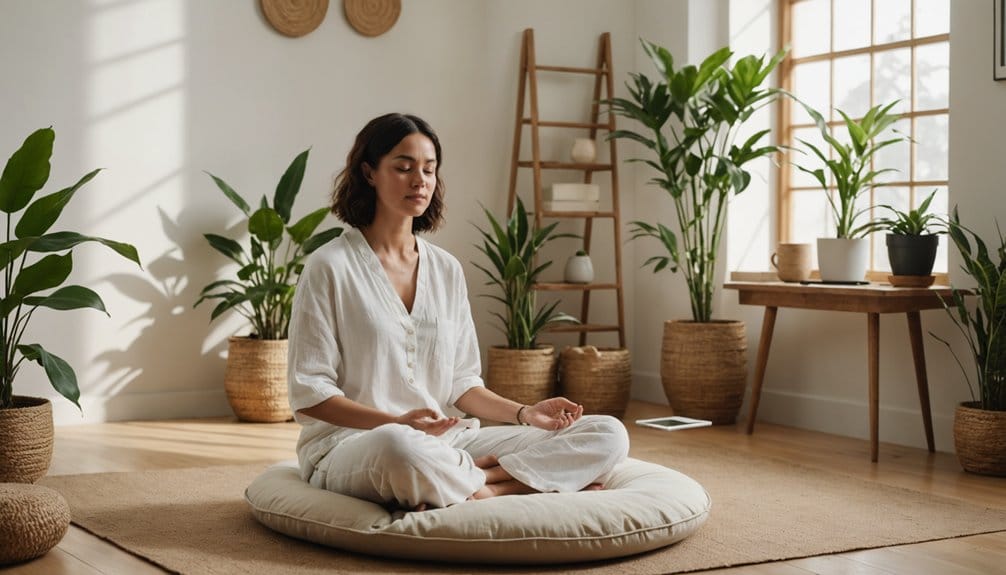
You’re simply being present, completely awake to this moment. No judgment, no effort – just you, breathing and existing. Pretty radical for our achievement-obsessed world, isn’t it? Creating a tranquil meditation environment helps deepen your practice by minimizing external distractions that could pull you from this state of pure awareness.
Mastering Koan Contemplation Through Extended Practice
While “just sitting” forms the bedrock of Zen practice, koan contemplation offers a different path to awakening – one that’ll make your brain do mental backflips. Think of koans as paradoxical puzzles that defy logical solutions. You can’t solve them through rational thinking alone.
Want to master koan practice? Start by selecting a traditional koan like “What is the sound of one hand clapping?” Sit with it for extended periods, letting it percolate in your mind without forcing answers. You’ll hit walls of frustration – that’s normal! But stick with it. Koan resolution often comes as sudden contemplative insights when you least expect them.
Advanced Breath Control Using Susokukan Method
You’ll find that mastering breath control through the Susokukan method starts with something deceptively simple – counting each breath with laser-like focus while maintaining proper hand positions called mudras. As your practice deepens, you’ll notice the subtle energy flow becoming more pronounced, almost like you’re learning to surf waves of consciousness (and yes, that’s as trippy as it sounds). While it might feel a bit awkward at first juggling these different elements, you’ll soon discover they work together seamlessly, creating a powerful meditation practice that’ll have you wondering why you ever thought watching cat videos was a good way to find inner peace. Similar to diaphragmatic breathing practice, this method creates a profound connection between your physical body and deeper consciousness.
Counting Breaths With Precision
Once you’ve mastered basic breath awareness, it’s time to level up with Susokukan – the advanced Japanese method of breath counting that’ll make your previous counting skills look like amateur hour.
Instead of casually tracking your breaths, you’ll now count with laser-like precision. Start by inhaling for exactly four counts, hold for two, then exhale for six. Sound easy? Just wait until you try maintaining this rhythmic counting while your mind wanders off to that embarrassing thing you said five years ago!
The secret lies in becoming one with each number. Don’t just mechanically count – feel the numbers resonating through your body. When you lose track (and trust me, you will), simply smile and start again. This isn’t about perfection; it’s about progress.
Deepening the Energy Flow
The advanced Susokukan method releases a deeper dimension of energy flow that’ll transform your meditation practice from basic breathing to full-body awakening. You’re about to tap into something profound – think of it as upgrading from a bicycle to a Tesla.
Start by expanding your energy awareness beyond just watching your breath. Feel the subtle vibrations coursing through your body with each inhale. Remember how you used to count breaths? Now you’ll ride their dynamic flow like a surfer catching waves. Let the energy build from your core and ripple outward.
Ever notice how some days you’re buzzing with energy while others you’re dragging? This technique helps you access that electric feeling on demand. Don’t worry if you feel silly at first – we’ve all been there, sitting cross-legged and wondering if we’re doing it right.
Mastering Sacred Hand Positions
Sacred hand positions, known as mudras in Susokukan practice, release powerful energy channels that transform your breath control into pure meditative magic. These hand gestures aren’t just fancy finger positions – they’re mindful expressions that create direct pathways to deeper spiritual alignment.
You’ll start with basic hand placements: rest your hands on your knees, palms up for receiving energy or down for grounding. As you progress, explore focus points by touching thumb to index finger (wisdom), middle finger (patience), ring finger (vitality), or pinky (communication). Each placement carries its own ritual significance.
Think of mudras as meditation aids that work like spiritual antenna – they’re catching and directing energy while you’re sitting there thinking “What do I do with my hands anyway?”
Developing Deep States of Samadhi in Zazen
Diving into deeper states of Samadhi during Zazen can feel like trying to catch a slippery fish with chopsticks – tricky at first, but immensely rewarding once you’ve got the hang of it. Start by exploring mindful imagery: picture yourself as a mountain, unmoved by passing clouds of thought. Let each breath anchor you deeper into stillness.
As your sensory awareness sharpens, you’ll notice the subtle shift from “doing meditation” to simply being. Remember how you learned to ride a bike? That moment when wobbling suddenly transformed into effortless balance? That’s what reaching Samadhi feels like. You’re no longer trying to meditate – you’ve become meditation itself.
Don’t get frustrated if your mind wanders. Even seasoned practitioners sometimes find themselves planning dinner during deep Zazen!
The practice’s holistic benefits extend beyond mental clarity to include improved physical wellness and emotional stability.
Integrating Walking Meditation With Seated Practice
You’ll notice that adding walking meditation to your seated practice feels like giving your mind a fresh set of training wheels. As you sync your breathing with each deliberate step, you’re building a natural bridge between stillness and motion that’ll supercharge your overall practice. Whether you’re taking mindful strides between formal sits or sneaking in a walking meditation during your lunch break, you’re creating a powerful one-two punch for your meditation game. This ancient practice of movement meditation techniques combines physical and mental healing to create transformative experiences that strengthen the mind-body connection.
Walking Complements Still Meditation
While sitting still in meditation builds inner stillness, walking meditation adds a dynamic dimension that’ll transform your practice. By matching your breath to your walking rhythm, you’ll discover a natural flow that deepens your mindfulness. Think of it as meditation in motion – where every step becomes an anchor for awareness.
You’ll find that mindful pacing helps break through those frustrating meditation plateaus. When your legs start tingling from sitting too long, a walking session can recharge your focus. Plus, let’s be honest – sometimes you need to scratch that “gotta move” itch without losing your zen groove.
The beauty of alternating between seated and walking practice is that each style reinforces the other. You’re basically getting a two-for-one deal on your path to enlightenment!
Syncing Breath With Steps
Three key breaths mark the rhythm for syncing your movement with mindful walking – inhale as you lift your foot, pause as it moves forward, and exhale as it touches down. This simple pattern creates a natural flow that’ll transform your practice from “just walking” into moving meditation.
Think of it like learning to dance – at first, you might feel awkward counting steps, but soon the mindful pacing becomes second nature. Ever notice how good runners seem to float? That’s rhythmic awareness in action. Start with ten steps, matching each to your breath. Don’t worry if you stumble at first – even Zen masters probably tripped over their robes while learning this technique. The key is finding your personal tempo, where movement and breath dance together in perfect harmony.
Transcending Dualistic Thinking in Advanced Practice
As your practice deepens, you’ll discover that many of life’s apparent opposites – good and bad, success and failure, self and other – aren’t truly separate at all. They’re more like different notes in the same song. When you sit in meditation, watch how your mind naturally tries to categorize everything into neat little boxes. Isn’t it funny how we do that?
Moving beyond these mental divisions is where non-dual awareness emerges. You might catch glimpses of it when you’re fully absorbed in an activity – maybe while painting, running, or even doing the dishes. In these moments, you’re experiencing unified consciousness without even trying. The boundary between observer and observed simply dissolves. The more you practice, the more you’ll notice these artificial separations falling away, revealing a more complete picture of reality. Just as mindful breathing techniques have ancient roots in Buddhist practices, this approach to transcending dualistic thinking has been cultivated for millennia.
Refining Body Posture for Extended Meditation Sessions
Many meditation newcomers focus so much on their mental state that they completely forget about their physical foundation. Your body’s posture alignment is just as vital as your mindset – after all, you can’t transcend if you’re fighting with a cramping leg!
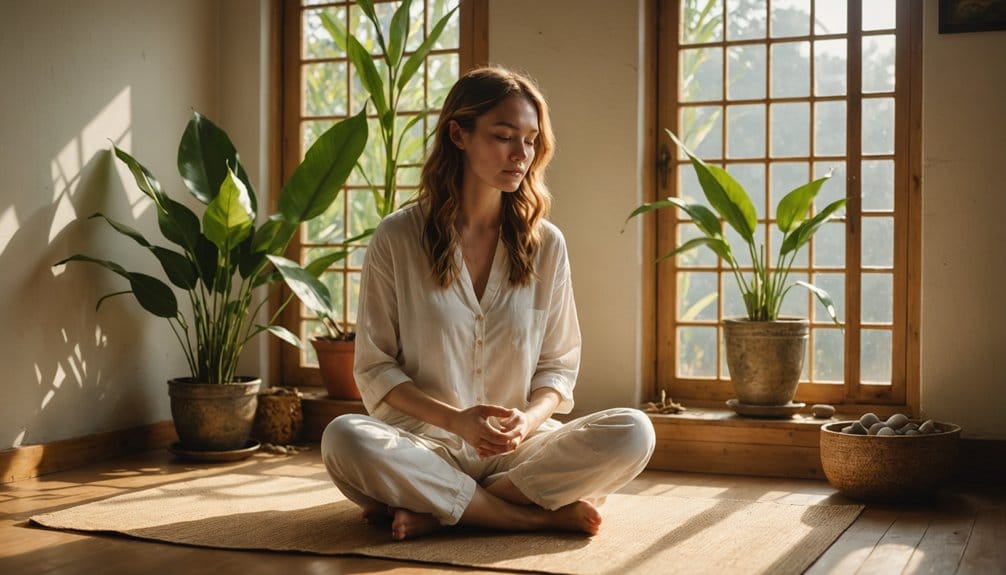
Start by finding your sweet spot of seated comfort through proper spinal support. You’ll want to stack your vertebrae like zen stones while maintaining core stability. Experiment with foot positioning until you find what works – there’s no shame in using meditation aids like cushions or benches. The key is sustainable body awareness that allows your breath rhythm to flow naturally.
Think of alignment techniques as your body’s meditation GPS. When everything’s properly positioned, you’re free to focus on what matters most – your practice itself.
Navigating Advanced States of Consciousness
While beginning meditators often chase the elusive “zen state,” you’ll discover that advanced consciousness isn’t about floating away on cosmic clouds – it’s about becoming more fully present than ever before. Think of it like turning up the brightness on your awareness dial. You’ll notice subtle perceptual shifts: colors seem more vivid, sounds clearer, and time flows differently.
Don’t freak out when strange sensations arise – that tingling in your limbs or feeling of expansion is totally normal. Your mind might serve up some wild imagery or insights that seem profound (and hey, maybe they are). The key is to stay grounded while exploring these states. Remember, you’re not trying to escape reality – you’re diving deeper into it. Watch these experiences like a curious scientist, neither grasping nor pushing them away.
Breaking Through Mental Barriers and Attachments
You’ll discover that breaking through mental barriers often starts with simply showing up – planting yourself on that meditation cushion even when your mind insists it has better things to do. As you sit in deep presence, you’ll notice how your thoughts cling to familiar worries and stories like a toddler clutching their favorite stuffed animal. The key is learning to smile at this resistance rather than fight it, letting your awareness gently loosen those mental fingers until releasing attachment feels as natural as exhaling.
Release Through Deep Presence
When mental barriers feel like concrete walls in your meditation practice, it’s time to explore the art of deep presence and deliberate release. Through sensory immersion and mindful acceptance, you’ll discover that letting go isn’t about forcing anything – it’s about surrendering to the present moment.
Start by focusing on depth awareness, noticing how your breath naturally flows without your interference. Isn’t it fascinating how your mind quiets when you stop trying to quiet it? Release techniques become more effective when paired with stillness exploration – simply observing thoughts as they drift by like clouds. Through emotional release and presence cultivation, you’ll find that mental surrender happens organically. Let existential reflection arise naturally, without grasping. Remember, you’re not trying to empty your mind; you’re learning to be fully present with whatever emerges.
Embracing Inner Resistance
Inner resistance shows up like an unwanted guest during meditation – that persistent voice telling you that you’re doing it wrong or should be somewhere else. Instead of fighting this inner dialogue, try embracing it through acceptance techniques. You’ll find that emotional resistance softens when met with compassionate awareness.
Think of resistance meditation as surfing waves rather than building walls. When distractions arise, greet them with curiosity through self inquiry: “What’s behind this restlessness?” This surrender practice gradually leads to ego dissolution, where you’re no longer wrestling with your thoughts but watching them float by. Remember, even the most experienced meditators face mental roadblocks – it’s part of being human! By developing mindfulness acceptance, you’ll learn that resistance itself can become your greatest teacher.
Embodying Mushin: The State of No-Mind
The ancient Zen concept of mushin represents a state of complete mental clarity – like a still pond reflecting the moon without ripples or distortion. You’ll recognize this state when your thoughts stop chattering and you’re fully present, acting without second-guessing yourself.
To embody mushin, start with basic mindfulness techniques: focus on your breath while letting thoughts float by like clouds. Don’t try to force inner stillness – that’s like trying to smooth water with your hands. Instead, watch your mind until the ripples settle naturally. Remember that time you were so absorbed in an activity that you lost track of time? That’s a taste of mushin.
Practice this during simple tasks first. Washing dishes? Just wash dishes. Walking? Just walk. You’re not trying to empty your mind – you’re becoming one with each moment.