Like a ship’s sail catching the wind, your breath holds the power to guide your meditation journey. You’ve probably noticed how your breathing changes when you’re stressed versus relaxed – but have you ever wondered why? Understanding breath control isn’t just about taking deeper breaths; it’s about releasing a natural tool you’ve had since birth. Whether you’re a meditation newbie or a seasoned practitioner, mastering your breath will transform your practice in ways you never imagined.
Understanding the Science Behind Breath and Meditation
While scientists have studied meditation for decades, they’re still amazed by how something as simple as breathing can rewire our brains. The neurobiological effects are fascinating – when you focus on your breath, you’re actually activating specific neural pathways that calm your nervous system. Pretty cool, right?
Think of breath awareness as your brain’s natural “chill pill.” When you consciously control your breathing, you’re tapping into an ancient system that’s been fine-tuned over millions of years of evolution. Your ancestors used the same mechanism to switch from “running from tigers” mode to “all is well” mode. Sure, you’re probably not fleeing predators these days, but your brain still responds to controlled breathing the same way – by triggering a cascade of relaxation responses that make meditation possible. Research shows that deep diaphragmatic breathing can create a powerful mind-body connection when practiced consistently for just 5-10 minutes each day.
The Foundation of Basic Breathing Patterns
Before diving into complex breathing techniques, let’s get comfortable with the basic patterns that’ll serve as your meditation foundation. Think of it like learning to walk before you run – except here, you’re learning to breathe consciously before becoming a meditation master.
Start with diaphragmatic breathing – it’s your body’s natural way of breathing, though most of us have forgotten it. Place one hand on your belly and notice how it expands with each inhale. Feels weird at first, right? But stick with it. Next, focus on nasal breathing. Your nose isn’t just for smelling coffee in the morning – it’s actually your body’s built-in air filter and breath regulator. Close your mouth, breathe through your nose, and notice how much calmer you feel. Who knew breathing could be so simple yet so powerful? This ancient Indian practice has been recognized for over 5,000 years as a powerful bridge between physical existence and higher consciousness.
Ancient Breathing Techniques From Various Traditions
You’ll find that ancient breathing practices from diverse spiritual traditions offer a fascinating toolbox of techniques that have stood the test of time. From the precise control of Buddhist pranayama to the subtle internal circulations of Taoist embryonic breathing, these methods have helped seekers find peace for thousands of years – and yes, they still work even if you can’t twist yourself into a pretzel. Whether you’re drawn to the hypnotic rhythms of Sufi circular breathing or the measured counts of pranayama, these time-tested approaches can transform your meditation practice from “Am I doing this right?” to “Ah, now I get it!” The 4-7-8 breathing method offers a modern adaptation of these ancient practices, providing instant calm through controlled breath cycles.
Buddhist Pranayama Methods
Though Buddhist meditation traditions span thousands of years and countless lineages, their breathing techniques share common threads that’ll feel surprisingly familiar to modern practitioners. You’ll discover how mindful inhalation can anchor you in the present moment, while compassionate exhalation releases tension you didn’t even know you were carrying.
Start by sitting comfortably – and no, you don’t need to twist yourself into a pretzel! Focus on your natural breath for a few cycles. Then, try extending your exhale slightly longer than your inhale. This simple adjustment helps activate your relaxation response. Ever notice how a long sigh feels so good after a stressful moment? That’s your body’s ancient wisdom at work, and Buddhist practitioners have refined this instinct into an art form.
Taoist Embryonic Breathing
While modern meditation often focuses on the breath as a simple anchor, Taoist embryonic breathing takes us deeper into the ancient art of energy cultivation. With roots in Taoist origins dating back thousands of years, this practice mimics the effortless breathing of a fetus in the womb – pretty cool, right?
You’ll start by softening your belly and letting your breath sink lower than you’re probably used to. Imagine you’re drawing embryonic energy up from the earth through your lower belly. Don’t worry if it feels weird at first – we all start somewhere! As you practice, you’ll notice your breathing becoming more refined and natural, just like a baby’s gentle breath. The key is patience and consistency. Think of it as reprogramming your breathing to its original, unconditioned state.
Sufi Circular Breathing Practices
As Sufi mystics discovered centuries ago, circular breathing creates an unbroken stream of life force that’ll leave you feeling like you’re floating on a magic carpet of pure energy. Through rhythmic Sufi breathwork, you’ll learn to inhale and exhale in continuous cycles while chanting sacred sound vibrations.
Want to try it? Start by sitting comfortably and breathing through your nose. As you inhale, imagine drawing energy up your spine. When you exhale, let the breath spiral down through your body like a gentle whirlpool. Once you’ve got the rhythm, add a gentle “hu” sound on the exhale – it’s the Sufi’s secret sound of the heart. Keep this going for 5-10 minutes and you might just find yourself swaying like a happy dervish in the cosmic dance.
Common Breathing Mistakes to Avoid
Despite years of breathing since birth, many people make surprising mistakes when it comes to mindful breathing during meditation. You might be falling into common traps without realizing it – shallow breathing that barely fills your lungs, or mouth breathing when your nose should be doing the work. Ever notice how you’re rushing those inhalations? That’s a classic mistake.
Your body craves a consistent rhythm, but distractions can throw you off track. When you lack awareness, tension builds up in your shoulders and jaw – yes, those spots you’re probably tensing right now! And here’s a funny thing: many meditators get so focused on breathing in that they neglect the equally important exhalation. Remember, it’s like a dance – both steps matter. Stay mindful of these patterns, and you’ll transform your practice. Developing controlled breathing techniques helps achieve a more balanced autonomic nervous system response, leading to better emotional regulation and mental clarity.
Integrating Rhythm and Timing in Your Practice
Once you’ve learned to avoid common breathing mistakes, finding your natural rhythm becomes the next frontier in meditation mastery. Think of rhythm integration as dancing with your breath – it’s not about forcing a beat, but discovering your own flow.
Start by noticing your natural breathing pattern for a few minutes. Is it quick and shallow? Slow and deep? There’s no wrong answer here – it’s just you being you. Now, gradually work on timing alignment by counting your inhales and exhales. You might try a 4-count in, 4-count out pattern. Don’t worry if you lose track – we’ve all counted to four and somehow ended up at seven! The key is to maintain consistency without becoming a drill sergeant about it. Your breath should feel like a gentle wave, not a military march. Mindful motion combined with breath awareness creates a powerful foundation for deeper meditative states.
Advanced Breath Control Methods for Deep States
You’re about to enter the big leagues of breath control with two powerful techniques that can take your meditation practice from “meh” to “whoa.” Box breathing – where you’ll count equal beats for inhaling, holding, exhaling, and holding again – might feel a bit like patting your head while rubbing your belly at first, but stick with it. Once you’ve got that down, you’ll graduate to extended exhale patterns, where you’ll stretch out your exhales like a lazy cat on a Sunday afternoon, training your nervous system to chill out on command.
Box Breathing Technique Mastery
Three key principles make box breathing a powerhouse technique for advanced meditation – and they’re surprisingly simple once you know them. First, you’ll want to master the 4-4-4-4 rhythm: inhale for 4 counts, hold for 4, exhale for 4, then pause for 4. Think of it as drawing a perfect square with your breath.
The box breathing benefits really shine when you add the second principle: visualization. Imagine tracing each side of a glowing cube as you breathe. Pretty cool, right? Finally, there’s the awareness anchor – staying present with each subtle shift in your body’s response. You’ll notice your shoulders dropping, mind clearing, and that pesky stress melting away. It’s like hitting your body’s reset button, but way more sophisticated than just counting sheep.
Extended Exhale Pattern Training
Building on the balanced rhythm of box breathing, extended exhale patterns take your meditation practice to new depths. You’ll discover that lengthening your exhale naturally calms your nervous system – it’s like finding the brake pedal for your racing mind.
Start by extending your exhale to twice the length of your inhale. If you breathe in for four counts, let that breath out for eight. The extended exhalation benefits include reduced anxiety and deeper relaxation states – pretty neat trick, right? When practicing exhale techniques, imagine deflating a balloon slowly and steadily.
Don’t worry if you feel a bit dizzy at first – that’s totally normal. Your body’s just saying “Hey, what’s this new thing we’re doing?” Take it slow, and you’ll soon master this powerful tool for reaching profound meditation states.
Customizing Breath Work for Your Meditation Style
Just as every person has their own unique walking style, breathing techniques can be tailored to match your preferred meditation approach. Your personalized breathwork journey should feel natural, not forced – like finding the perfect pair of jeans that just fits.
Want to energize your morning meditation? Try rapid, rhythmic breaths. Seeking calm after a hectic day? Slow, deep breathing might be your go-to. These adaptable techniques work like a customizable toolkit for your mental state. You’ll know you’ve found your rhythm when it feels as comfortable as humming your favorite song.
Don’t be afraid to experiment. Mix and match different patterns until something clicks. Remember, there’s no “meditation police” checking if you’re doing it “right” – your breath is as unique as your fingerprint.
Creating a Sustainable Daily Breathing Practice
While finding the right breathing technique feels like discovering treasure, maintaining a daily practice can sometimes seem as tricky as keeping New Year’s resolutions past January. But here’s the thing – creating rituals doesn’t have to be complicated.
Start by setting intentions each morning and incorporating affirmations that resonate with your goals. Use mindful reminders – maybe it’s a phone alert or a sticky note on your mirror – to prompt your practice at consistent times. Building habits becomes easier when you track your daily progress, whether through a simple journal or meditation app.
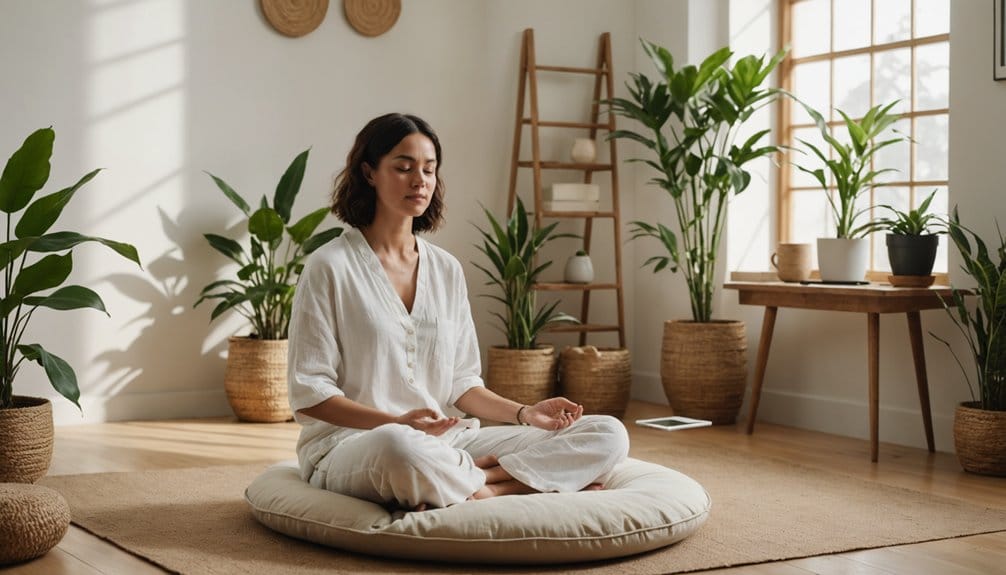
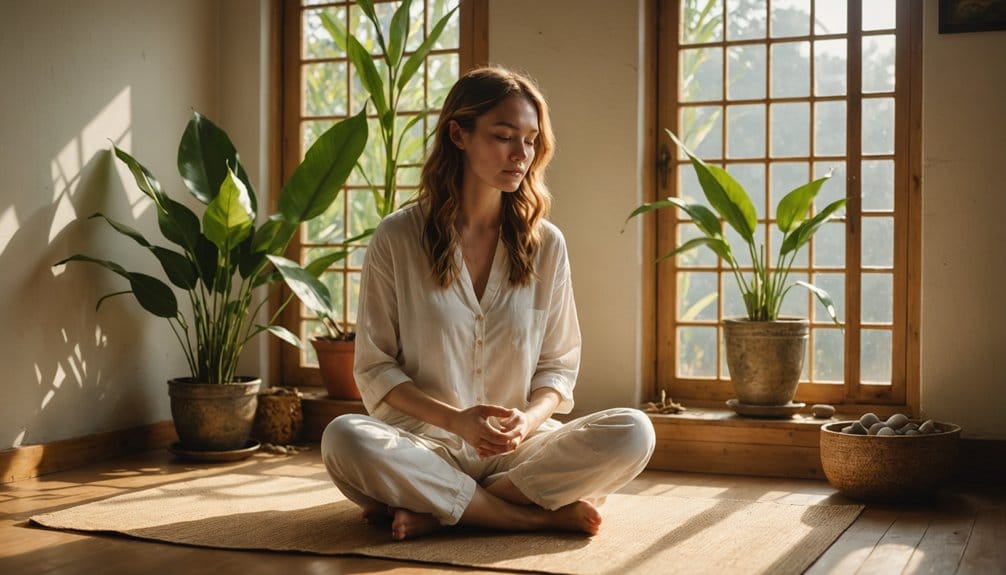
Want to enhance focus? Create a dedicated breathing space in your home. It could be as basic as a comfy cushion by the window. Remember, you’re not aiming for perfection – you’re cultivating freedom through consistency, one breath at a time.