You’ve probably tried everything to calm those racing thoughts – from counting sheep to stress-eating an entire pizza (hey, we’ve all been there). But what if the answer to managing anxiety isn’t about adding more to your plate, but rather emptying it? Zen meditation isn’t just another wellness trend – it’s a scientifically-backed practice that literally reshapes your brain. Before you roll your eyes at another “life-changing solution,” let’s explore why this ancient practice might be exactly what your frazzled mind needs.
The Science Behind Zen Meditation and Anxiety Relief
While scientists once viewed meditation as purely spiritual practice, research now shows it creates measurable changes in your brain that help reduce anxiety. Recent neuroscience insights reveal that consistent Zen practice actually shrinks your amygdala – that pesky fear center that loves to send you into panic mode. Ever wonder why experienced meditators seem so annoyingly calm? Their brains have literally rewired themselves for peace.
The meditation benefits go beyond just feeling more relaxed. You’ll develop a thicker prefrontal cortex (fancy terms for your brain’s “wise controller”), which helps you pause before spiraling into worry. Think of it as upgrading your mental software – except instead of paying for premium features, you’re just sitting quietly and breathing. Your anxious brain won’t know what hit it! Studies have shown that emotional regulation improves significantly with regular Zen meditation practice, leading to greater mental clarity and stability.
Understanding the Mind-Body Connection in Zen Practice
Those brain changes from meditation are fantastic, but there’s more to the story than just neurons firing differently. When you practice Zen meditation, you’re not just training your mind – you’re creating a powerful bridge between your thoughts and physical sensations. Ever notice how your shoulders tense up when you’re stressed? That’s your mind-body connection in action!
Through regular practice, you’ll develop deeper mind awareness of how your thoughts affect your body, and vice versa. You’ll catch yourself holding your breath during anxious moments and learn to release that tension. Better emotional regulation becomes second nature – like having an internal thermostat for stress. Instead of letting anxiety build up until you’re ready to pop, you’ll recognize the early warning signs and know exactly how to reset yourself. Much like pranayama-based meditation techniques, this ancient approach creates a profound connection between breath and consciousness.
Essential Components of Zen Meditation Techniques
You’ll want to start your Zen meditation journey by settling into a comfortable but upright posture – and no, slouching on the couch while scrolling through social media doesn’t count! Your breath becomes your anchor as you let it flow naturally through your nose, noticing its rhythm without trying to control it. As thoughts pop up like spirited puppies wanting attention, you’ll practice simply observing them float by without getting caught up in their stories – it’s like watching clouds pass across the sky of your mind.
Posture and Breathing Basics
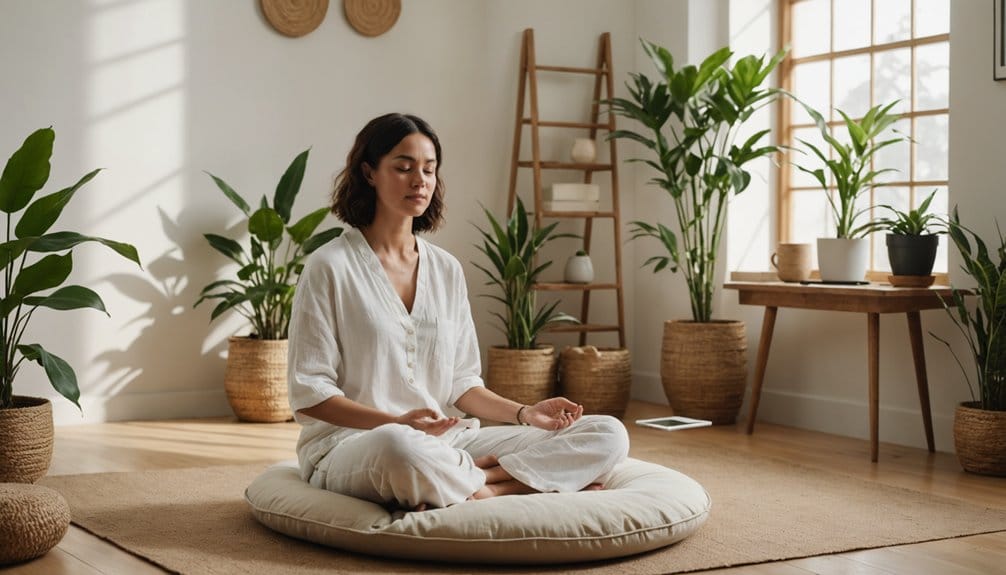
Learning proper posture and breathing techniques forms the essential foundation of Zen meditation – think of it as your meditation “power stance.” Just like a wobbly chair can’t support you during a lengthy dinner party, poor meditation posture won’t serve you well during practice. You’ll want to establish correct alignment by sitting cross-legged on a firm cushion, keeping your spine straight but not rigid. Picture yourself as a mountain – stable, dignified, and naturally at ease.
Your breath is your anchor to mindful presence. Don’t try to control it; simply notice its natural rhythm. Remember, you’re not training to be a champion breath-holder here! Let each inhale and exhale flow like gentle waves on a quiet beach. When your mind wanders (and trust me, it will), just return to that steady rhythm.
Focus Through Silent Observation
While sitting quietly in meditation might seem like you’re doing nothing at all, silent observation is actually where the real magic happens. Through mindful observation, you’ll notice thoughts floating by like clouds in the sky – some stormy, others light and fluffy. Don’t chase them; just watch them pass.
Think of yourself as a curious scientist studying your own mind. What patterns do you notice? Silent awareness helps you spot those pesky anxiety triggers without getting tangled up in them. It’s like watching a movie where you’re both the audience and the main character – pretty meta, right?
Creating Your Personal Meditation Space and Routine
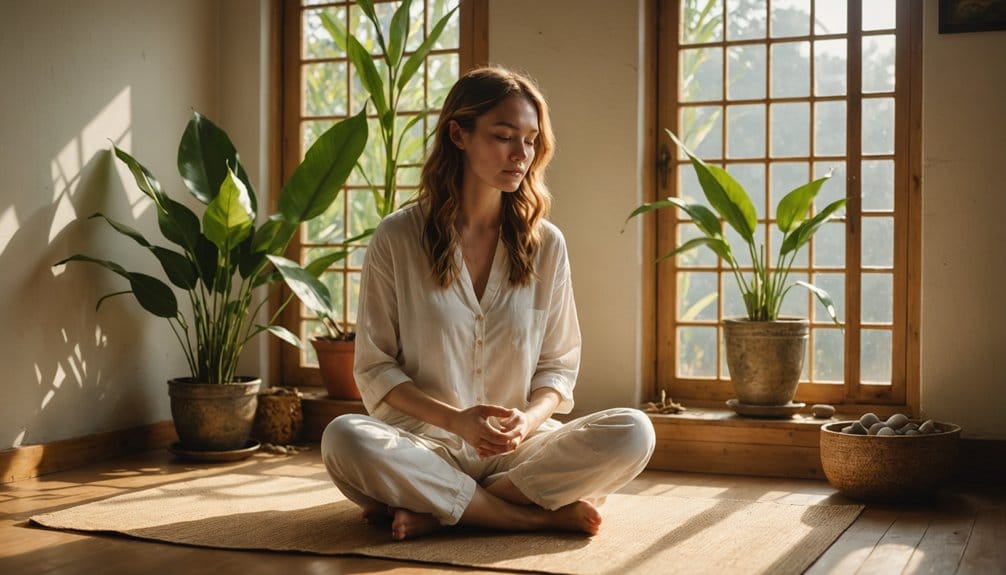
Since a peaceful environment sets the foundation for effective meditation, establishing your dedicated space and routine deserves careful consideration. Creating ambiance doesn’t require a complete home makeover – even a quiet corner with a comfy cushion can become your sanctuary. You’ll want to experiment with personal rituals that resonate with you, whether it’s lighting a candle or simply adjusting the blinds to your preferred level of natural light.
The key is consistency in both location and timing. Ever notice how your favorite coffee shop feels instantly welcoming? That’s what you’re aiming for in your meditation space. Maybe it’s that cozy spot by the window, or perhaps it’s a corner of your bedroom where the morning sun hits just right. Trust your instincts – you’ll know when it feels right.
Breathing Methods for Anxiety Management
You’d be amazed how something as simple as breathing properly can turn your anxiety from a roaring lion into a purring kitten. When anxiety strikes, your first line of defense is deep breathing – filling your lungs completely while counting to four, then letting that breath out slowly like you’re trying to make a feather float. The key is focusing on those long, controlled exhales, which tell your nervous system it’s safe to relax (even if your brain is still busy making elaborate worst-case scenarios).
Deep Breathing Techniques
Breathing sits at the heart of effective anxiety management, yet most of us take this natural process for granted. Let’s face it – when’s the last time you actually thought about your breath? Probably when you were huffing up those stairs after skipping the gym again.
Diaphragmatic breathing isn’t just fancy jargon – it’s your ticket to inner calm. Place your hand on your belly and feel it rise as you inhale deeply through your nose for four counts. Hold that breath like you’re keeping a secret, then release it slowly through your mouth. This rhythmic inhalation pattern tells your nervous system “hey, we’re safe here!” Your body’s clever that way – it can’t distinguish between real threats and work deadlines. By controlling your breath, you’re basically giving your anxiety a timeout.
Focus on Exhaling Slowly
Although inhaling deeply matters, the real magic happens when you master the art of slow exhaling. Think of it like deflating a balloon – not all at once, but with controlled precision that calms your entire system. Your exhale rhythm becomes your anxiety’s kryptonite.
Ever notice how you can’t panic and breathe slowly at the same time? It’s physically impossible! By focusing on extending your exhale to twice the length of your inhale, you’re basically telling your nervous system, “Hey, we’re good here.” Breath awareness becomes your superpower – you’ll start catching those shallow, anxious breaths before they spiral. And here’s a fun tip: pretend you’re slowly blowing out birthday candles without extinguishing them. It’s impossible to stay tense when you’re playing this mental game!
Common Challenges and How to Overcome Them
When first starting a Zen meditation practice, it’s natural to encounter some speed bumps along the way. Maybe your mind wanders to that embarrassing thing you said five years ago, or your neighbor’s dog won’t stop barking. Don’t worry – you’re not failing at meditation, you’re just being human.
Overcoming distractions begins with accepting them as part of the process. Notice them, then gently guide your attention back to your breath. That wandering mind of yours? It’s like a puppy that needs training – and cultivating patience is key. Try setting realistic goals: start with just 5 minutes of meditation and gradually increase your time. Remember, even experienced practitioners face challenges. The difference is they’ve learned to smile at their monkey mind and keep going anyway.
Integrating Zen Principles Into Daily Life
Zen meditation extends far beyond those peaceful moments on your cushion. It’s about bringing that same mindful awareness into every corner of your daily life – yes, even during that chaotic morning commute!
Start by practicing mindful eating. Instead of scrolling through your phone while wolfing down lunch, actually taste your food. Notice its texture, temperature, and flavor. You’ll be amazed how much more satisfying meals become when you’re fully present.
Try peaceful journaling to capture those scattered thoughts that fuel anxiety. Don’t worry about perfect prose – just let your pen flow freely for five minutes each day. You can even turn routine tasks into mini-meditations: washing dishes, folding laundry, or walking the dog. Before you know it, you’ll find pockets of peace in places you least expect them.
Measuring Progress and Maintaining Practice
Since starting your meditation practice, you’ve probably wondered if you’re “doing it right” or making any real progress. Here’s the funny thing about Zen – the moment you try to measure your progress, you’re actually getting further from the goal! But don’t worry, there are still practical ways to track your journey without getting caught up in the numbers game.
Instead of obsessing over minutes meditated or counting breaths, notice the subtle shifts in your daily life. Are you sleeping better? Taking fewer trips down the anxiety rabbit hole? Maybe you’re not flipping out when someone cuts you off in traffic anymore. These real-world changes matter more than any meditation stats. For sustaining commitment, treat your practice like brushing your teeth – it’s just something you do, no questions asked.